


Headboards with Storage
In many bedrooms, the problem isn't a lack of furniture but rather too much of it: two cluttered nightstands, a wall shelf, books piling up. A headboard with storage tackles the issue at its source by integrating niches, shelves and sometimes drawers directly into the wall of the bed, right where evening essentials are actually used. It's one of the most effective solutions in our headboard collection for saving space without sacrificing comfort. This page will help you choose the right type of built-in storage and the right dimensions for your bedroom.
Why choose a headboard with storage?
The idea is simple: bring storage closer to where you actually use it. Applied to the bedside area, it transforms both the organisation and the feeling of space.
Keep the essentials within reach without multiplying furniture
Books, a lamp, an alarm clock, glasses, a notebook: bedside items are few but used every single day. Rather than spreading them across two nightstands and a shelf, a headboard with storage brings them together within arm's reach, in niches accessible from the bed. The benefit is twofold: fewer pieces of furniture in the room, and a smoother evening routine, with everything in its rightful place. If nightstands remain, they can take a more discreet role — a simple tray will do — or disappear from one side of the bed altogether.
Make the most of small bedrooms and narrow spaces
In a small bedroom, every floor-standing piece of furniture comes at the cost of circulation space. By moving storage onto the vertical plane of the bed wall, a headboard with storage frees up floor area without sacrificing any functionality. This is smart space-saving at its best: you're not adding a piece of furniture, you're replacing two. Paired with a floating bedside table, it allows you to create a complete bedside setup where the floor remains almost entirely clear — a decisive advantage in narrow or attic bedrooms.
What types of storage should you integrate into a headboard?
Not all built-in storage serves the same purpose: the right mix depends on what you want on display and what you'd rather keep out of sight.
Open niches for everyday bedside essentials
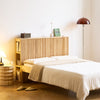
Open niches are the heart of the system: positioned at pillow height, they hold your current read, a lamp, an alarm clock, a glass of water. Their strength lies in immediate accessibility — no fuss, even when lying down. Check their depth and layout: two or three well-placed niches are worth more than one long continuous shelf where everything gets jumbled together. For avid readers, the more generous models echo the spirit of a bookcase headboard, with proper rows of books built right into the bed wall.
More discreet storage to maintain a clean, uncluttered look
If you prefer a visually calm bedroom, opt for closed or concealed storage: integrated drawers, top-opening compartments, side niches facing outward and invisible from the room. These solutions absorb less aesthetically pleasing items — chargers, boxes, notebooks — while keeping the overall look clean and understated. The pared-back feel remains intact: from the front, the headboard looks like a beautiful panel; in practice, it works like a fully functional storage unit.
Between these two approaches, it's also worth thinking about electricity: a reading lamp, a phone charger, an alarm clock. Some models include a discreet cable management channel; if not, check the proximity of a power outlet before installation. A niche with a cable running across the front loses some of its elegance — but planned ahead, this detail makes the headboard truly self-contained and confirms its role as the centrepiece of your bedside setup.
How do you choose the right dimensions without overwhelming the bed?
A headboard with storage is deeper than a simple panel — that's the key point to plan for. Start by measuring the available length in the room: the depth of the unit, often between fifteen and thirty centimetres, adds to that of the bed, and circulation at the foot of the bed must remain comfortable. In terms of width, align it at minimum with your mattress — most commonly 140 or 160 cm — with, if space allows, an overhang that visually incorporates the nightstands. As for height, it should remain proportionate: a model that's too tall will overpower the bed, while one that's too low loses its shelf function. If you have a 160x200 bed, a 160 wood headboard provides a good reference for proportions; for a compact double bed, the 140 wood headboard is the go-to choice. One final tip: don't fill every niche. Airy shelves with a few carefully chosen objects keep the storage looking like a design asset rather than a source of visual clutter.
Think about the material too: wood remains the benchmark for this type of furniture, offering both structural stability and visual harmony with the rest of the room. A lighter tone visually lightens a piece that is, by nature, more substantial than a simple panel; a deeper tone, on the other hand, leans into its role as a statement piece. In either case, connect the headboard to an existing element in the room — a nightstand, a chest of drawers or a bed frame — so that the built-in storage feels considered from the outset rather than added as an afterthought. It's often this tonal connection that sets a harmonious bedroom apart from a simple collection of functional furniture.
Nordlys headboards with storage: practicality, space-saving and comfort
Nordlys headboards with storage are designed for real evening use: niches accessible from the bed, shelves sized for books and everyday objects, stable wood structures and natural finishes in a functional Scandinavian spirit. They are particularly well suited to small bedrooms and narrow spaces, but find their place just as naturally in a larger room, where they elegantly replace a wall shelf. Before making your choice, simply list what needs to live near your bed, measure the depth your room can accommodate, and decide what your nightstands will continue to hold: the right model will make itself obvious. And if you're still unsure how much storage you actually need, try the simplest test there is: for one week, observe what genuinely accumulates on your bedside table. That's exactly what your future headboard will need to accommodate — no more, no less — and it's the best guarantee of a truly functional choice rather than a purely theoretical one.


